Last reviewed June 2026 by the White Card Practice AU editorial team.
About this topic
Spotting hazards before they cause harm is the heart of construction safety, and it is one of the most tested skills on the White Card (CPCWHS1001). You do not need to be an expert, you just need to know how to look, how to judge the risk, and what to do about it. This page explains the essentials, then lets you practise with real exam-style questions.
Hazard vs risk: know the difference
These two words are often confused, and the test loves to check it. A hazard is anything with the potential to cause harm, for example a trailing power lead, a chemical, or an unguarded edge. A risk is the likelihood that the hazard will actually hurt someone, combined with how serious that harm could be. Identifying hazards is step one; assessing the risk is step two.
The hierarchy of control
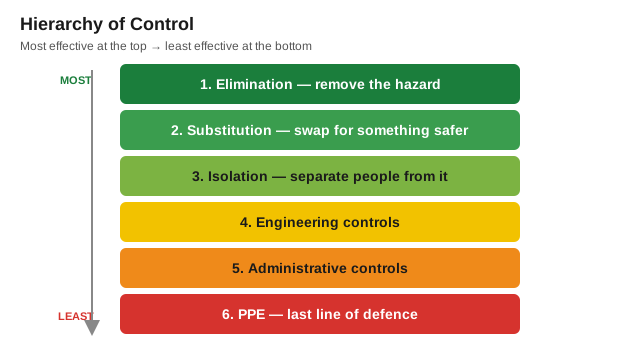
When you find a hazard, the law expects you to control it using the hierarchy of control, from most effective to least effective:
- Elimination – remove the hazard completely (the best option).
- Substitution – swap it for something safer.
- Isolation – separate people from the hazard (barriers, exclusion zones).
- Engineering controls – guardrails, machine guards, ventilation.
- Administrative controls – training, signs, safe work procedures.
- PPE – personal protective equipment, the last resort.
PPE is last because it only protects the individual wearing it and does nothing to remove the hazard itself.
How to spot hazards on site
Good hazard spotting is a habit: look up (powerlines, falling objects), look down (trip hazards, holes, leads), and look around (moving plant, edges, other trades). Common hazard types include physical (noise, electricity, moving machinery), chemical (fumes, dust), ergonomic (heavy lifting, awkward postures), and environmental (heat, weather).
What to do when you find a hazard
Never walk past a hazard assuming someone else will deal with it. If it is safe and within your control, fix it or isolate it. Otherwise, report it to your supervisor straight away and warn others nearby. Reporting hazards is part of every worker's duty under WHS law.
Key facts to remember
- A hazard is a potential source of harm; a risk is the likelihood and severity of that harm.
- Control hazards using the hierarchy of control, from elimination down to PPE.
- PPE is the least effective control because it only protects one person.
- Everyone on site has a duty to identify and report hazards.
- Risk management is a cycle: identify, assess, control, then review.
Frequently asked questions
What is the difference between a hazard and a risk?
A hazard is anything with the potential to cause harm. A risk is the likelihood that the hazard will actually cause harm, combined with how serious that harm could be.
What is the hierarchy of control?
It is the ranked list of ways to control a hazard, from most to least effective: elimination, substitution, isolation, engineering controls, administrative controls, and finally PPE.
Why is PPE the last resort?
Because PPE only protects the person wearing it and does nothing to remove the hazard. Higher controls like elimination or engineering fixes protect everyone.
What should I do if I spot a hazard?
Control or isolate it if you safely can, warn anyone nearby, and report it to your supervisor immediately. Reporting hazards is a legal duty for every worker.
Sample exam questions
Try these example questions, then practise the full set with our free quiz.
Q. Which is the most effective control in the hierarchy of control?
- A) PPE
- B) Elimination
- C) Safety signs
- D) Training
Answer: B. Elimination removes the hazard entirely and is the most effective control; PPE is the least effective.
Q. What is a 'hazard'?
- A) The likelihood of harm
- B) Anything with the potential to cause harm
- C) An injury that has occurred
- D) A type of control
Answer: B. A hazard is a potential source of harm; risk is the likelihood and severity of that harm.
Q. You spot a hazard you can't safely fix yourself. What should you do?
- A) Ignore it
- B) Report it to your supervisor and warn others
- C) Leave the site
- D) Wait for it to cause an incident
Answer: B. Reporting hazards is a duty of every worker; warn others and escalate to your supervisor.
Related topics
Ready to test yourself?
Our 552-question bank includes dedicated drills for every topic.
Start Hazard Identification drill Full practice test