Last reviewed June 2026 by the White Card Practice AU editorial team.
About this topic
Construction safety signs in Australia follow the standard AS 1319. Being able to read a sign instantly — by its colour and shape alone — can keep you safe and is a guaranteed topic on the White Card (CPCWHS1001) assessment. This page breaks down the categories so you can recognise any sign at a glance.
The main sign categories
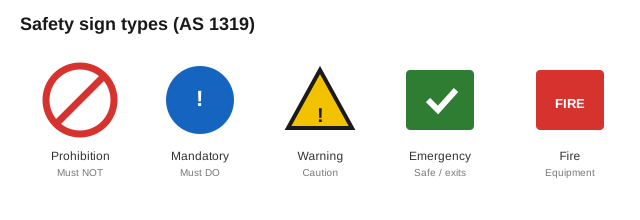
Under AS 1319, signs fall into clear groups defined by colour and shape:
- Prohibition – red circle with a diagonal line. Tells you what you must not do (e.g. No Entry, No Smoking).
- Mandatory – solid blue circle. Tells you what you must do (e.g. Hard Hat Must Be Worn).
- Warning – yellow triangle with black border. Warns of a hazard to be careful of (e.g. Slippery Surface).
- Danger – the word DANGER in white on a red oval, on a black-and-white sign. The most serious warning, used where there is a risk of death or serious injury.
- Emergency information – green with white symbols. Shows the location of safety equipment, first aid and exits.
- Fire – red signs that show the location of firefighting equipment.
Read the colour and shape first
You can identify a sign's purpose before you even read the words. Red means prohibition or fire; a blue circle means something is mandatory; a yellow triangle means warning; and green means safety/emergency information. This is why the colours are standardised, so the message is clear even at a distance or to someone in a hurry.
Signs support safety, they don't replace it
A sign is an administrative control. It warns and informs, but it does not physically remove a hazard. Always follow the instruction a sign gives, and never assume a missing sign means an area is safe.
Key facts to remember
- Australian safety signs follow AS 1319.
- Red circle with a line = prohibition (must not); fire signs are also red.
- Blue circle = mandatory (must do).
- Yellow triangle = warning; DANGER signs are the most serious warning.
- Green = emergency information, first aid and exits.
- Signs are an administrative control and do not remove the hazard.
Frequently asked questions
What does a blue safety sign mean?
A solid blue circle is a mandatory sign, it tells you what you must do, such as wear a hard hat or hearing protection.
What is the difference between a Danger and a Warning sign?
A yellow triangle Warning sign flags a hazard to be careful of. A DANGER sign (white text in a red oval) is more serious and is used where there is a risk of death or serious injury.
What colour and shape is a prohibition sign?
A prohibition sign is a red circle with a diagonal line through it, showing something you must not do.
Do safety signs replace other safety controls?
No. Signs are an administrative control that warn and inform. They support safety but do not physically remove a hazard, so you must still follow safe work procedures.
Sample exam questions
Try these example questions, then practise the full set with our free quiz.
Q. What does a solid blue circular sign mean?
- A) Prohibition
- B) Warning
- C) Mandatory (you must do something)
- D) Danger
Answer: C. A blue circle is a mandatory sign, e.g. 'hard hat must be worn'.
Q. What shape and colour is a warning sign under AS 1319?
- A) Red circle
- B) Yellow triangle with black border
- C) Green square
- D) Blue circle
Answer: B. Warning signs are yellow triangles that alert you to a hazard.
Q. A red circle with a diagonal line through it means?
- A) Mandatory
- B) Prohibition (you must not)
- C) Emergency information
- D) Fire equipment
Answer: B. A red circle with a line is a prohibition sign, e.g. 'no entry'.
Related topics
Ready to test yourself?
Our 552-question bank includes dedicated drills for every topic.
Start Safety Signs & Tags (AS 1319) drill Full practice test